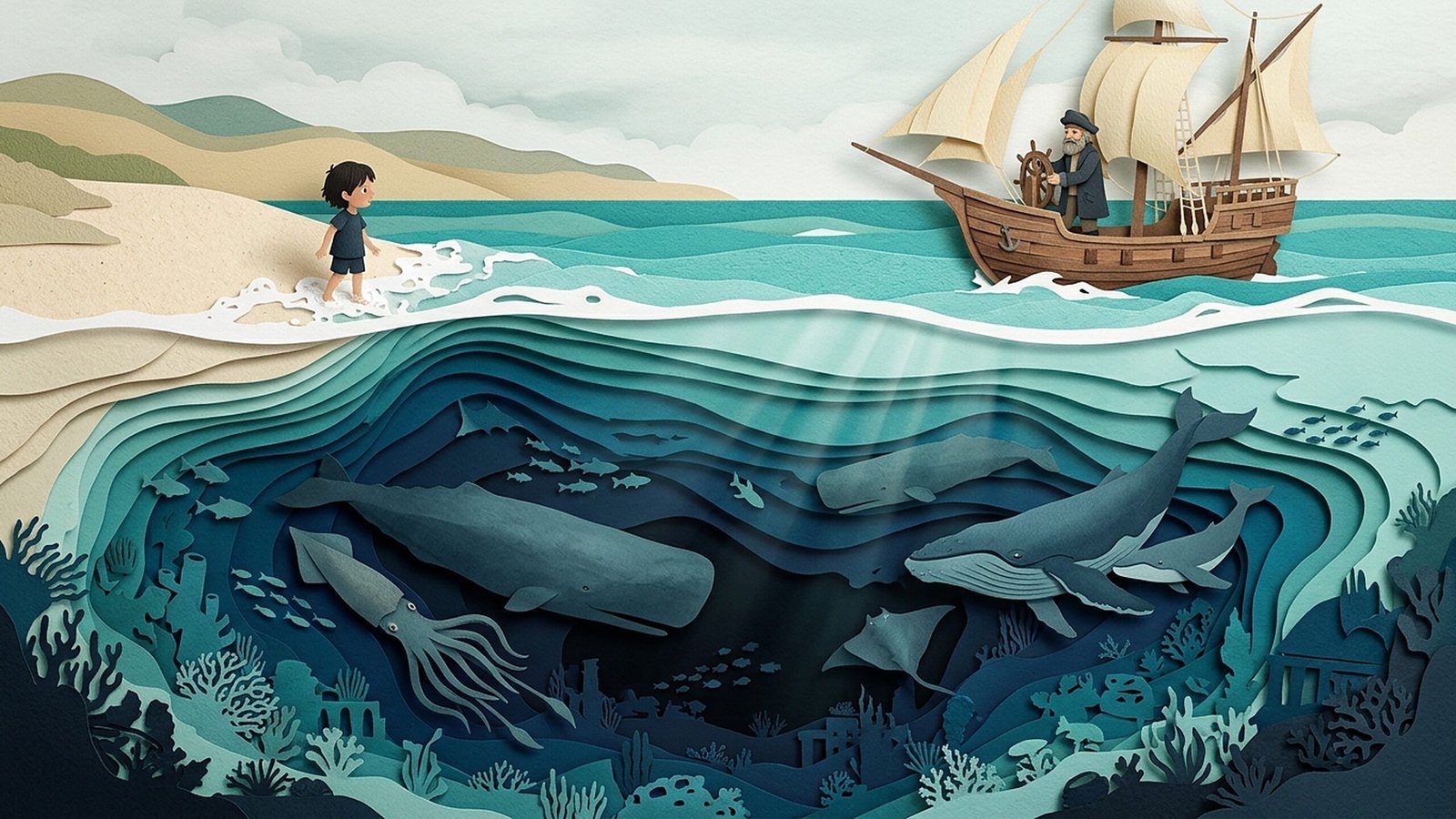
There was a child who, at about ten years of age, came to her father and said: “Daddy, I would like to see the sea.” Her father, turning to her, replied: “My daughter, if you pass the year with good grades I will take you to see the sea.” The child held on to her father’s words and worked hard all year to get good grades. When the year ended, she brought her report card to her father, reminding him of the promise he had once made. The father looked at her and said: “All right, my daughter, this vacation we will go see the sea.” Arriving at the beach, the child went straight to the water. Wetting her feet in the sea she smiled happily. She had finally seen the sea!
Nearby was a beautiful caravel that gave tours along the coast. Excited, the father took the child on one of those tours. The captain who sailed that caravel was a very experienced man. He knew the winds, the currents, the beauty and the dangers of the ocean. He knew enough to keep all his passengers safe. Approaching that old captain the little girl asked: “Sir, do you know the sea? Because I know it!” She continued: “I have already studied the sea, read books in school, and today I even got into the water.” Intrigued, that captain recalled some of his experiences on the high seas and thought to himself: “Does she really know the depths and the grandeur of the ocean?”
This tale illustrates the reality of our relationship with God. Like the ocean, the knowledge of God can be vast and deep. We live in times when knowledge has become scraps of information searched on Google. In milliseconds you can gather information about anything that exists in the world. This is Wikipedia knowledge, quickly digested without much discernment. We also live in a time when wisdom can be summed up in 140 characters on Twitter. We prefer short, punchy phrases to the complexity of teachings. The knowing of today is detached from experience; it is instant and shallow. This is the zeitgeist of our time.
Spiritually we can recognize the same tendency when it comes to the knowledge of God. Many of us are like this little girl. We wet our feet in the shallow waters of the knowledge of God, never sailing into its depths, and we live in the deception that our immediate experiences are enough. This reality was well exposed by Leonard Ravenhill, one of the great prophets of the church in the twentieth century. Looking at the current generation and the pattern of the heroes of faith in the Bible, he declared: “We are paddling at the shoreline of the ocean of the possibilities of God’s grace.”
In Christ, our lives can be seen as boats sailing the ocean of the Spirit, the ocean of the possibilities of God’s grace. The knowledge of God is not purely intellectual knowledge, or the mere gathering of information and data about God’s character. Knowing God is based on relational experience that begins when we are introduced to Him through Jesus Christ: the experience of the new birth and of life in community and worship. Like in our tale, the knowledge of God is a substance, and this substance can be measured. But contrary to educational standards, we do not measure the knowledge of God by the information we can retain, but by the application of this knowledge in our lives. The knowledge of God is experiential. In this way, knowing God is directly linked to letting ourselves be known by Him in constant dialogue.
Our tale reveals two realities, that of the girl and that of the captain. Both can affirm, with all sincerity, that they know the sea. Both can speak of their experience and what they felt. But only one can speak of the knowledge that goes beyond the shores. Of the knowledge that comes through risks taken, dangers and struggles faced, and experiences from venturing beyond what we consider our safe harbor and comfort zone. Only one can speak of the knowledge that comes when we let the sea interrupt our lives. When we yield control to the wind of the Holy Spirit, and when we are carried by currents that go beyond our own will. Only one can speak of the knowledge that comes through perseverance and goes beyond the superficiality of what we consider fun and pleasurable. Even though both know the sea, only the captain can affirm that he still has much to learn.
Don’t stop seeking!